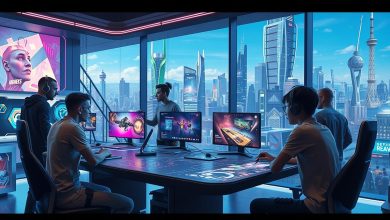
Technology is no longer content with simply catching up to our needs. These days, it races ahead, often taking cues from the realm of science fiction. What was once the stuff of futuristic novels and silver-screen spectacles is now embedded in our smartphones, homes, and even our bodies. This isn’t just evolution—it’s a high-speed leap into a tech-enhanced future.
Welcome to the era where sci-fi becomes Wi-Fi.
In this article, we’ll explore the fantastic journey of futuristic concepts that have crossed over from science fiction into reality. From holograms to AI, teleportation research to wearable tech, we’ll dive deep into the innovations shaping our modern world.
The Sci-Fi Blueprint: A Glimpse into the Past
From the visionary worlds of Isaac Asimov and Arthur C. Clarke to modern epics like Black Mirror and The Matrix, science fiction has long served as a mirror to our technological aspirations and anxieties. These authors weren’t just dreamers—they were prophets, predicting inventions that seemed impossible at the time.
Consider this:
- In 1968’s 2001: A Space Odyssey, video calls were a futuristic concept.
- Star Trek’s “communicators” eerily resemble today’s smartphones.
- Dick Tracy’s two-way wrist radio? Now called a smartwatch.
Fiction planted the seeds. Innovation watered them. Now, we’re harvesting a future once confined to pages and pixels.
- Artificial Intelligence: From Sentient Robots to Everyday Assistants
Remember HAL 9000 from 2001: A Space Odyssey? Or the charming-yet-terrifying Ava from Ex Machina? AI in science fiction has always had a flair for drama. But in the real world, it’s a little more… helpful.
Today, AI powers everything from Siri and Alexa to customer service bots and advanced medical diagnostics. Machine learning algorithms drive recommendation engines, facial recognition, language translation, and even financial trading.
While we haven’t quite reached sentient androids with emotional depth, companies like OpenAI and Google DeepMind are developing large language models capable of reasoning, generating content, and mimicking human-like conversations with startling accuracy.
What was once a fantasy is now a foundation of our daily digital experience.
- Augmented Reality & Holograms: Blending Realities
Star Wars showed us Leia’s holographic message. Iron Man brought holographic design tools to life. For years, these visuals were dismissed as special effects magic. But now?
- AR apps let you overlay furniture in your living room before buying.
- Microsoft’s HoloLens allows engineers and surgeons to visualize 3D models in real-time.
- Concerts have featured holographic performances of late artists like Tupac and Whitney Houston.
We are still refining true “free-standing” holograms, but the line between digital and physical realms has blurred—especially in gaming, retail, and education.
- Wearable Tech: Cyborg Style Becomes Practical
Science fiction always flirted with the concept of wearable enhancements—from RoboCop to Deus Ex.
Today, wearable tech is subtle but powerful:
- Smartwatches monitor health, track workouts, and connect us to the web.
- Smart glasses, like Ray-Ban Meta and Google Glass, offer AR functionality.
- Medical wearables track glucose, detect arrhythmias, and even administer insulin.
We may not have Iron Man suits (yet), but your wristwatch could save your life.
- Voice-Controlled Devices: Talking to Machines
In Knight Rider, David Hasselhoff chatted with his car. In Her, Joaquin Phoenix fell in love with his OS.
Now? You can tell your car to find a coffee shop, your thermostat to warm the house, and your phone to read you the news. Voice-controlled devices have exploded:
- Smart speakers are household staples.
- Voice assistants are now embedded in phones, fridges, cars, and TVs.
- Call centers are increasingly automated through voice AI.
Conversational AI is not just novelty—it’s productivity.
- Self-Driving Cars: Auto-Pilot Becomes Auto-Reality
Self-driving cars have long been a sci-fi dream—from I, Robot to Total Recall. But thanks to Tesla, Waymo, and others, autonomous vehicles are no longer theoretical.
We’re not fully driverless yet, but many cars now include semi-autonomous features:
- Lane detection
- Self-parking
- Adaptive cruise control
- Emergency braking
Full autonomy is being tested in cities around the world. The question is not if but when these vehicles will become mainstream.
- The Internet of Things: A Connected Everything
In many futuristic visions, technology talks to technology. Your fridge knows you’re out of milk. Your watch knows when you’re tired. Your coffee machine starts brewing the moment your alarm goes off.
Welcome to the Internet of Things (IoT).
From smart doorbells to AI-powered irrigation systems, everything is becoming interconnected. This is more than convenience—it’s a new operating system for life.
And it’s all powered by Wi-Fi and cloud computing—a far cry from dial-up.
- Space Travel: From Moonshots to Mars Dreams
We watched fictional astronauts conquer Mars long before Elon Musk tweeted it into reality. Today:
- SpaceX lands reusable rockets.
- NASA’s Artemis missions aim to return humans to the Moon.
- Private companies plan space tourism.
We’re inching closer to commercial space travel. Maybe not warp-speed voyages yet, but the stars are no longer so far away.
- Brain-Computer Interfaces: Mind Over Machine
Mind control always fascinated sci-fi fans. From The Matrix to Ghost in the Shell, direct brain-to-computer interaction was considered fantastical.
Enter Neuralink and other neurotech ventures. Scientists have already enabled people with paralysis to control devices with their thoughts. BCIs (brain-computer interfaces) are poised to transform medicine, gaming, and communication.
While we’re in early stages, the implications are massive and surprisingly real.
- Virtual Worlds & The Metaverse: Escaping Reality
Ready Player One, Tron, The Matrix—fictional metaverses depicted total immersion in digital worlds.
Today, virtual platforms like VRChat, Meta’s Horizon Worlds, and Decentraland let users interact, play, build, and even earn inside persistent 3D worlds. VR headsets offer deeper immersion, and blockchain adds digital ownership.
While the term “metaverse” is still evolving, the idea of living in a digital universe is no longer abstract.
Even online casinos are venturing into virtual reality, offering interactive tables, slots, and live dealers in 3D spaces. One rising star in this scene is casinocorner, a platform that merges cutting-edge tech with traditional gaming, offering users a fully immersive betting experience—sci-fi style.
- Cloning & Genetic Engineering: The Code of Life
From Gattaca to Jurassic Park, sci-fi often explored the power of editing life itself.
CRISPR and gene-editing tools have made it possible to alter DNA with precision. Scientists are working on treatments for genetic diseases, designer crops, and even reviving extinct species.
While the ethical debates rage on, one thing is clear: the future of biology has arrived.
So… What’s Still Sci-Fi?
While many concepts have leapt off the screen and into our hands, some remain out of reach—at least for now:
- Teleportation
- Time travel
- Lightsabers
- Warp drives
- Colonizing other planets
But as we’ve seen, what’s impossible today may be possible tomorrow.
Science fiction isn’t just a genre. It’s a blueprint. A whisper from the future, daring us to build it.
And judging by the pace of innovation, we’re listening.
Conclusion: Living the Future
We are no longer passive consumers of fiction—we’re co-creators of reality. From talking to our devices to exploring other planets, the world we live in today is one that yesterday’s dreamers imagined.
Just as easily as we play at a mobile casino from our couch or speak to an AI assistant in our car, the surreal has become second nature.
As we move forward, technology will continue to borrow from the bold, bizarre, and beautiful visions of science fiction. It’s a partnership between imagination and engineering, storytelling and science.