
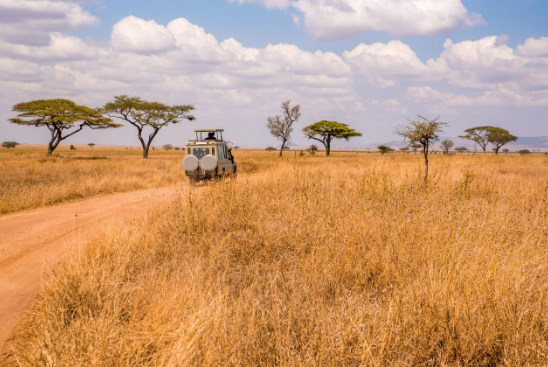
On a Serengeti safari, animals don’t appear by luck. They show up because the land allows them to. You notice this almost immediately. One moment you’re rolling across an open plain where everything feels exposed and honest. Later that same day, the vehicle slows near a river, and the mood shifts. Shade tightens around you. Sounds soften. Even the guide’s posture changes. By evening, woodlands close in, and the day ends quietly, with more listening than looking.
The Serengeti National Park teaches you to notice the ground before the movement. Once you do, wildlife sightings begin to make sense. Not as isolated moments, but as part of a living system that’s always responding to itself.
Open plains and grazing herds
The plains are where the Serengeti feels endless. Flat, wide, and exposed, they give animals room to see danger long before it arrives. After rain, the grass pushes up fast and green, and that’s when the herds drift in. Wildebeest. Zebra. Gazelle. Sometimes buffalo, dark shapes against the grass.
What stands out isn’t just the numbers. It’s how early you notice them. Movement comes before detail. A long line on the horizon. A faint haze of dust. And then the realization that it’s alive.
This is where the Great Wildebeest Migration feels real. Not as a dramatic headline moment, but as a steady, purposeful movement across space. A Tanzania Safari on the plains helps you grasp scale in a quiet way. You stop thinking in single sightings and start thinking in patterns.
River systems and moments of tension
Rivers pull everything inward. Unlike the plains, they narrow life into corridors. Water matters more here, especially as the land dries out. Elephants arrive with intent, digging into sandy banks. Hippos hold territory. Crocodiles barely move at all.
And predators wait.
Near rivers, animals don’t relax. You can sense it. Heads lift. Bodies pause. Every step toward water looks measured. Guides slow down here, reading tracks and listening for alarm calls instead of scanning the horizon.
During a Tanzania Safari Tour, river areas often carry the most tension. Not because something always happens, but because it could. You feel the risk before you see it.
Woodlands and quiet encounters

Woodlands change the rhythm again. Trees soften the light. Visibility drops. And suddenly the safari feels personal. Lions stretch in the shade, half-hidden. Leopards disappear into branches you would have missed without guidance. Cheetahs linger at the edges, waiting for open ground to do its work.
Here, wildlife doesn’t announce itself. It reveals itself slowly. A snapped twig. A call you don’t recognize. The engine cuts. Everyone waits.
And patience matters.
This is where you realize a Serengeti safari isn’t about constant action. It’s about attention. Guides rely on experience here more than optics. And you start doing the same.
Seasons quietly redraw the Serengeti
Rain changes more than color. During wet months, grasslands spread, and water appears where there was dust weeks earlier. Animals spread out too, following fresh grazing rather than fixed points. The land feels generous and loose.
Dry months pull everything back together. Grass thins. Rivers become magnets. Wildlife gathers, and movements feel easier to anticipate.
This is why understanding the Best Time to Visit Tanzania matters. It isn’t about good or bad seasons. It’s about what kind of behavior you want to witness. The same place can feel calm or charged, open or intense, depending entirely on rainfall and timing.
How animals respond to terrain

Animals don’t wander aimlessly. They react. Plains encourage long movement. Rivers force decisions. Woodlands offer rest, concealment, and strategy.
That’s why migration herds stay in open grassland. Why predators cluster where habitats overlap. Why do certain areas feel alive year after year, even when the sightings change?
Once you start seeing this, a Tanzania Safari feels connected rather than random. Every encounter links back to the ground beneath it.
Why landscape awareness changes a safari
When travelers understand landscapes, safaris deepen. You stop asking where the animals are and start wondering why they might be here today. Why now. Why this stretch of land?
Our guides read the terrain first, then look for wildlife. That’s how they anticipate movement instead of chasing sightings. That’s how a drive becomes more than a checklist.
And honestly, it changes how you sit in the vehicle. You watch differently. You wait better.
Different landscapes, different moods
Plains feel open and restless. Rivers feel alert, almost uneasy.
Woodlands feel close and quiet.
Move through all three in a day, and the Serengeti feels complete. Not staged. Not repetitive. Just balanced.
That’s the power of landscape. It influences what you see, how you feel, and what stays with you long after the dust settles.


